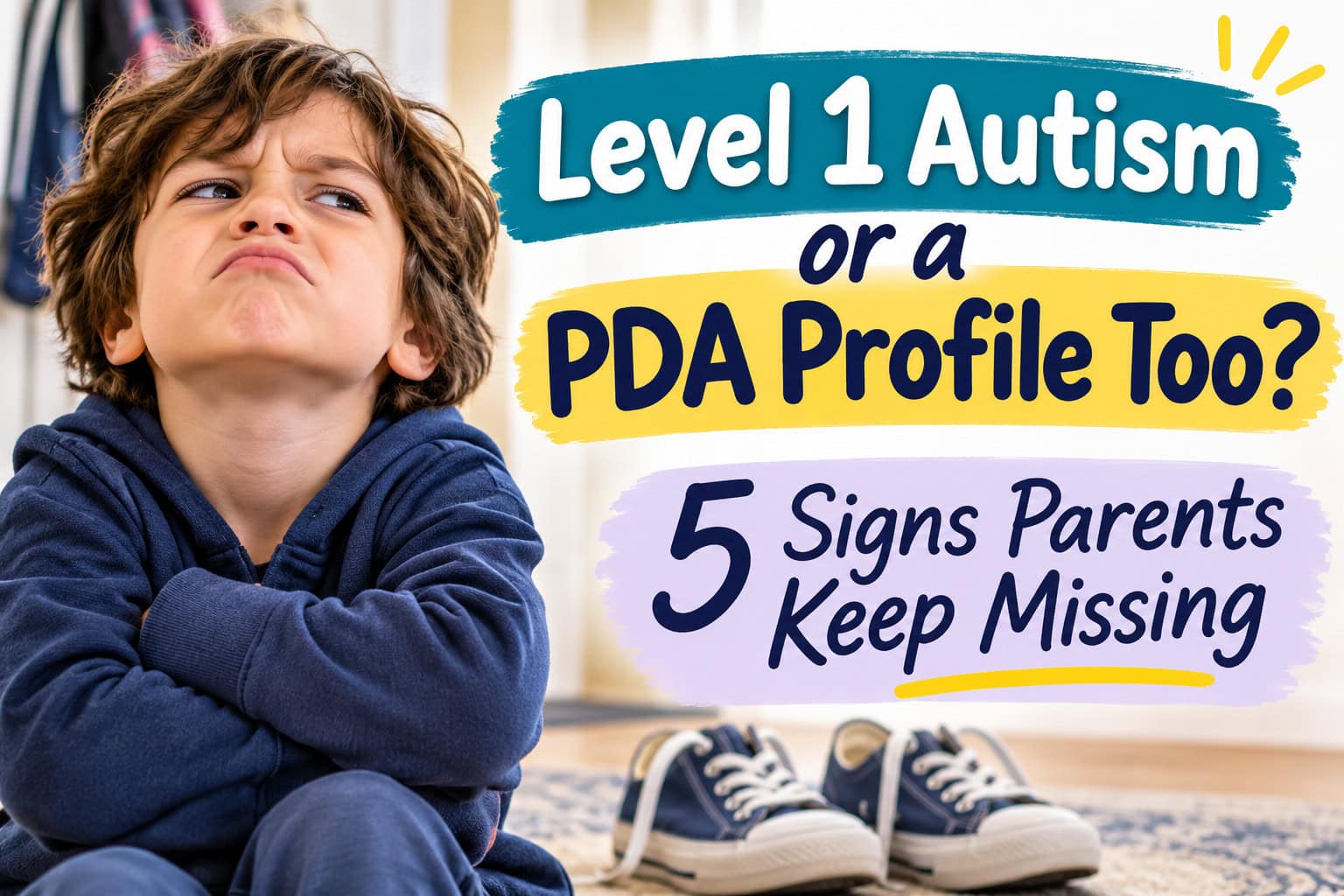
Level 1 Autism or a PDA Profile Too? 5 Signs Parents Keep Missing
Your child has Level 1 autism. But why does EVERYTHING turn into a battle?
You ask them to brush their teeth. NO.
You tell them it’s time to get dressed. NO.
You offer two choices because that’s what every parenting expert on the internet tells you to do.
And somehow, BOTH choices are wrong.
At this point, you’re wondering if your child just wakes up every morning determined to argue with you about absolutely everything.
But what if there’s something else going on?
What if your child has a PDA profile, too?
PDA stands for Pathological Demand Avoidance, although some people prefer the term Persistent Drive for Autonomy.
It’s a term used to describe a pattern where everyday demands can trigger unusually intense resistance or distress, sometimes even when the child actually WANTS to do the thing.
And while PDA isn’t a separate official diagnosis, the struggles parents describe are very real.
So let’s talk about five patterns that might make you wonder whether your Level 1 autistic child also has a PDA profile.
1. They Refuse Things They Actually WANT to Do
This one makes parents absolutely CRAZY.
Your child has been begging to go to the playground ALL morning.
You finally say, “Okay! Let’s go!”
And suddenly?
They won’t put their shoes on.
They won’t get dressed.
They don’t want to go anymore.
And you’re standing there thinking, “BUT THIS WAS YOUR IDEA!”
Here’s what might be happening.
Sometimes, the moment something turns from an idea into an expectation, it starts to feel completely different.
Now there’s a transition. There’s getting ready. There’s a timeline. There’s someone expecting them to do something.
And suddenly, something they genuinely wanted to do feels overwhelming.
What to try: Instead of repeating “PUT YOUR SHOES ON!” five more times, get curious about what’s making that step difficult.
Maybe it’s the transition. Maybe it’s the shoes themselves. Maybe it’s the pressure of having to do it RIGHT NOW.
Because those are three different problems, and they may need three different responses.
2. The More You Push, the WORSE It Gets
You know that moment when you ask your child to do something simple, and they say no?
So you ask again.
Still no.
You explain why it’s important.
NO.
You offer a reward.
NOPE.
You threaten a consequence.
And now you’ve got a full-blown meltdown over brushing teeth.
And you’re thinking, “HOW DID WE GET HERE?”
For some children with a demand-avoidant profile, the more pressure they feel, the harder it becomes to do what’s being asked.
And here’s where parents get stuck.
They think they need to be MORE consistent. MORE firm. MORE persistent.
But sometimes, increasing the pressure is the very thing making the situation worse.
What to try: When you see the interaction escalating, stop adding more words.
You don’t have to abandon the expectation. But you may need to change HOW you’re approaching it.
Instead of another reminder, try:
“We need to get teeth brushed before bed. What’s going to make that easier?”
And if your child is already completely overwhelmed? Save the problem-solving for later.
3. They Reject EVERY Choice You Offer
Oh, this one.
“Do you want the red cup or the blue cup?”
“NEITHER!”
“Do you want to get dressed before breakfast or after?”
“NO!”
And you’re thinking, “I’M LITERALLY GIVING YOU CONTROL!”
Except here’s what we sometimes miss.
For some children, being asked to choose is STILL a demand.
Now they have to process the question, make a decision, and respond.
And if they’re already struggling, even that can feel like too much.
Or maybe neither choice actually solves the problem.
If your child’s clothes feel awful against their skin, choosing WHEN to get dressed isn’t going to help.
What to try: Stop assuming more choices automatically mean less pressure.
Sometimes a simple statement works better.
“Your clothes are on your bed. Let me know if you need help.”
And sometimes your child needs a clear, direct instruction instead.
The point is to figure out which approach actually helps YOUR child.
4. They Can Do Something UNTIL You Ask Them to Do It
I think this is one of the most confusing patterns for parents.
Your child is happily cleaning their room.
They’re putting toys away. Organizing things. Getting stuff done.
You walk in and say, “Oh, awesome! Can you put those books away too?”
And just like that?
THEY STOP.
Now they’re arguing.
Or walking away.
Or refusing to finish.
And you’re standing there wondering what on earth just happened.
Because they were LITERALLY ALREADY DOING IT.
For some children, there’s a big difference between doing something because they chose to and doing something because someone else expects it.
The activity hasn’t necessarily changed.
But the feeling surrounding it has.
And sometimes that changes everything.
What to try: If your child is independently doing something productive, consider whether you really need to add another instruction.
Sometimes the most helpful thing you can do is let them keep going.
And when you do need to step in, pay attention to how your involvement affects their ability to continue.
5. Their Reactions Seem WAY Bigger Than the Request
You ask your child to come to dinner.
They scream.
You tell them it’s time to turn off the video game.
They panic.
You ask them to get dressed.
They completely fall apart.
And someone inevitably says, “They’re being so dramatic.”
But here’s what I want you to think about.
Just because a request seems SMALL to you doesn’t mean it feels small to your child.
Getting dressed might involve uncomfortable clothing, stopping a preferred activity, making decisions, and getting ready for a day they’re already worried about.
Coming to dinner might mean leaving something they love, entering a noisy room, and dealing with foods they find overwhelming.
That’s a LOT more than simply “come eat.”
And when those demands pile up, your child may reach a point where they just can’t manage one more thing.
So Is It Level 1 Autism or PDA?
Here’s where things get interesting.
It’s not necessarily an either-or situation.
Some Level 1 autistic children are also described as having a PDA profile.
But not every autistic child who refuses demands has PDA.
And not every child who argues, avoids chores, or struggles with transitions has PDA either.
Anxiety can make demands difficult.
ADHD can make getting started feel impossible.
Sensory sensitivities can turn ordinary activities into miserable experiences.
And sometimes a child is simply overwhelmed by everything that’s already happened that day.
There’s also ongoing debate about how PDA should be defined and identified, so these five patterns aren’t a diagnostic checklist.
Which is why I care a whole lot more about understanding what’s driving the behavior than immediately putting another label on it.
Because once we understand what’s making something difficult, we can start figuring out what to DO about it.
Here’s Where My Village of Littles Nervous System Lens™ Comes In
Let’s say your child refuses to put on their shoes.
You could assume they’re being defiant.
You could offer a reward.
You could threaten to take away screen time.
You could stand there repeating yourself for 20 minutes.
OR…
You could start looking at the pattern.
Maybe your child was doing fine until you told them it was time to leave.
Maybe they’re already overwhelmed because they slept poorly.
Maybe getting dressed involves sensory discomfort.
Maybe the expectation itself creates distress.
Through my Village of Littles Nervous System Lens™, we look at what’s building your child’s load, what happens to their access when that load increases, and how to respond in a way that actually matches what’s happening.
I describe this through three states:
Available: Your child has better access to communication, flexibility, and everyday skills.
Strained: The demands are building, and things that were manageable earlier may start becoming harder.
Protective: Your child is overwhelmed, and getting through the moment may take priority over meeting expectations.
And here’s why that matters.
The response that helps your child when they’re Available may be completely different from what helps when they’re already Protective.
Same child. Different state. Different access.
Three Things You Can Start Doing Differently TODAY
First, stop repeating the same demand when it’s clearly making things worse.
If you’ve asked five times and your child is becoming increasingly distressed, a sixth reminder probably isn’t the missing ingredient.
Reduce the pressure. Give them a little space. See whether you can identify what’s getting in the way.
Second, pay attention to WHEN the resistance happens.
Is it worse in the morning?
After school?
When they’re tired?
When someone interrupts something they’re enjoying?
When plans change unexpectedly?
Those patterns can tell you a lot more than the behavior alone.
Third, stop assuming every refusal needs the same response.
Sometimes your child needs help getting started.
Sometimes they need a sensory accommodation.
Sometimes they need more predictability.
And sometimes they’re so overwhelmed that they need recovery before they can manage another expectation.
That’s why generic parenting advice doesn’t always work.
Because the right response depends on what’s driving YOUR child’s struggle.
And If You’re Thinking, “Okay, But What Am I Actually Supposed to DO?”
That’s exactly why I work with parents individually.
Because I know how exhausting it is when every morning feels like a negotiation, every transition becomes a battle, and you’re constantly wondering whether you should push, help, or back off.
In my First Step Parent Strategy Session, we spend an hour looking at YOUR child’s patterns.
We identify what’s building their load, where they’re getting stuck, and what may be making everyday expectations so difficult.
And you leave with THREE practical, individualized responses you can start trying.
Not another generic list of parenting tips.
Strategies based on what’s actually happening with YOUR child.
Because recognizing the pattern is one thing.
Knowing what to DO when it happens?
That’s where things can start to change.
Stephanie Kerwin, M.Ed.
Village of Littles
Note: PDA is a proposed profile, not a separate formal diagnosis. Demand avoidance can have many causes, and these examples aren’t intended to diagnose autism or PDA. If you’re concerned about your child’s development, a qualified professional can help evaluate the broader picture.